
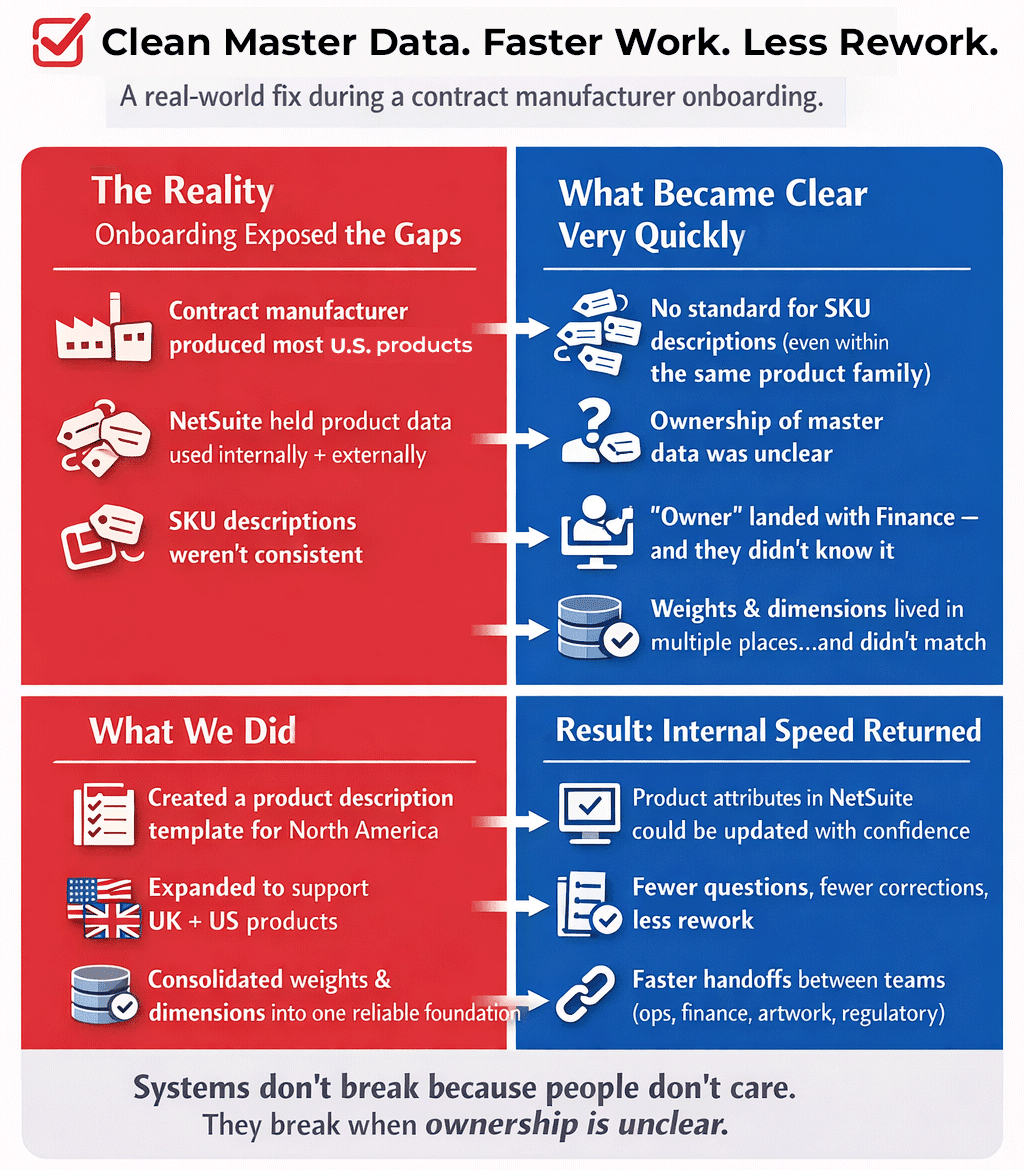
A real-world fix during a contract manufacturer onboarding.
Outcomes
- Standard SKU description template created (U.S. → U.S. + UK)
- Weights & dimensions consolidated into one reliable foundation
- NetSuite product attributes updated with confidence (faster handoffs, less rework)
What I found inside the work
If you’ve lived inside an ERP, you know what happens next:
The confusion doesn’t stay in the “data.”
It shows up everywhere else.
So I asked what I’ve learned is usually the first real question:
Who owns master data?
That question led me to the Finance Manager — who had no idea that responsibility had been placed on them.
And that’s the moment a lot of organizations get stuck.
Not because people don’t care.
Because the work has no clear owner.
What we built to move fast
I volunteered to help and started with something simple and practical:
A product description template that could be used consistently across North America — both in NetSuite and in how product information was communicated outside the business.
It wasn’t fancy. It didn’t need to be.
It needed to help a busy team make consistent decisions, quickly.
Then we discovered the next layer: the naming convention had to support the UK as well, not just the U.S.
So we revised the template and widened the standard to work across both geographies.
The second fix: weights and dimensions had no home
Later, once I stepped into the artwork coordinator role, another gap surfaced:
We had no reliable repository for product weights and dimensions.
Those numbers lived in a mix of places — different sources, different versions — and inconsistencies you couldn’t ignore once you saw them.
So I did what you do when speed depends on trust:
- gathered the sources
- compared them
- normalized the data
- created a single foundation that could be relied on
At that point, I accepted ownership of that slice of master data — descriptions, weights, and measures — so we could update NetSuite product attributes from one place with confidence.
What changed
This wasn’t a “data cleanup project” for its own sake.
It was about restoring internal speed.
Once the foundation was in place:
- product attributes in NetSuite could be updated with confidence
- teams spent less time correcting, debating, and backtracking
- handoffs between operations, finance, artwork, and regulatory got easier
- the business wasn’t paying an invisible “confusion tax” every day
Systems don’t break because people don’t care.
They break because ownership is unclear.
If you can’t point to the owner, consistency becomes optional… until the day it becomes urgent.
Clean master data isn’t about perfection.
It’s about speed you can trust.
If your team is moving slower than it should — and nobody can quite explain why — master data is often one of the quiet culprits. If you want a simple way to sanity-check SKU descriptions, weights, and dimensions (and assign clear ownership), I’m happy to share what’s worked for me.
0 Comments